The Next AI Revolution Is Not About Thinking. It Is About Touching the World.
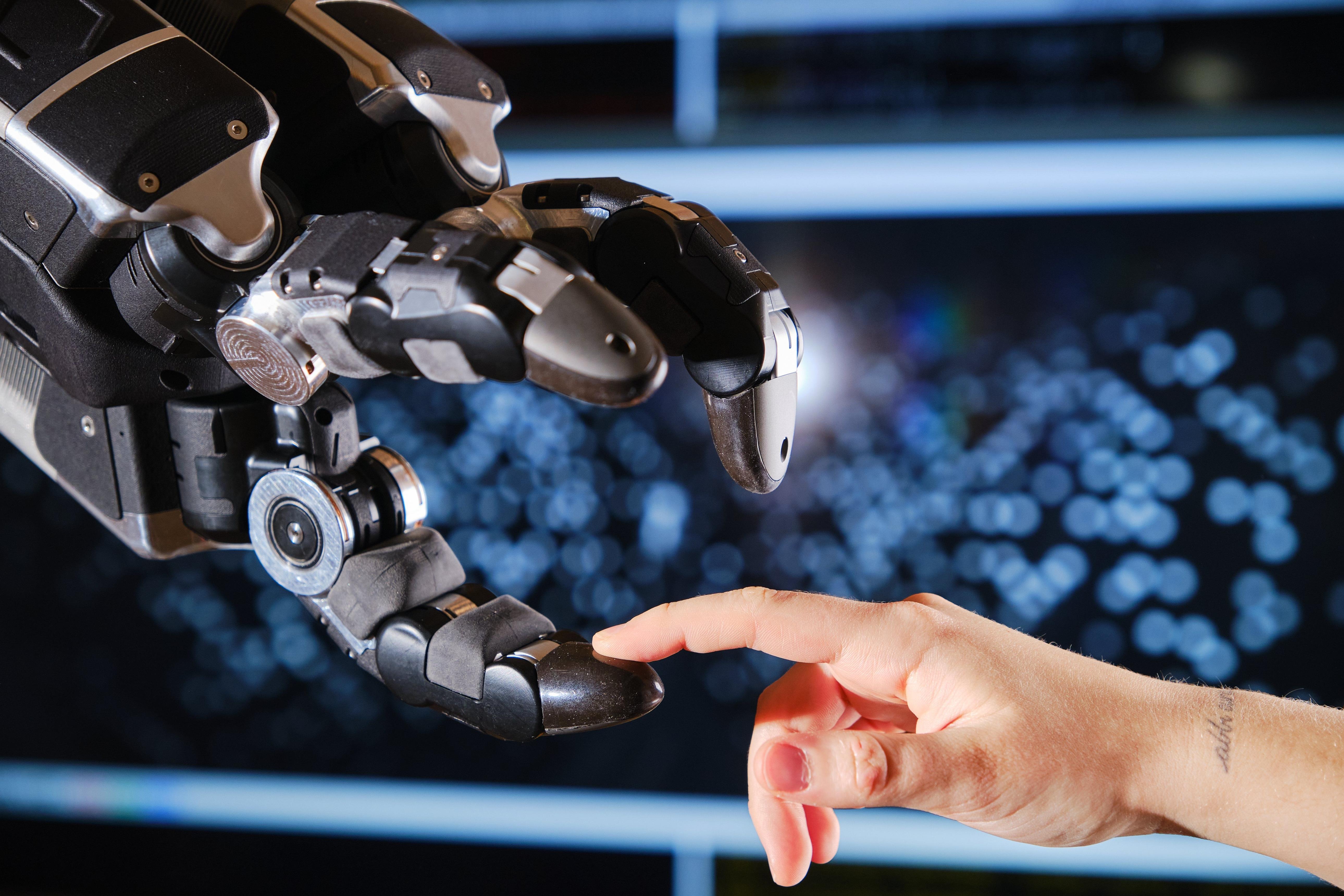
The Next AI Revolution Is Not About Thinking. It Is About Touching the World.
Why robotic hands could become the missing link between artificial intelligence, physical labor, and the future of human civilization.
For years, the artificial intelligence revolution has been unfolding primarily on screens.
AI writes reports, generates images, develops software, analyzes financial data, answers questions, and increasingly performs tasks that once required years of professional training. Yet, despite these remarkable advances, one fundamental limitation remains: intelligence inside a computer cannot automatically translate into the ability to act in the physical world.
An AI system may explain how to repair an engine, identify a damaged component, and generate a detailed repair procedure. But physically reaching into a crowded engine compartment, recognizing the resistance of a bolt, adjusting pressure, and replacing the component without damaging surrounding parts is an entirely different challenge.
This distinction points toward a potentially transformative development in technology: the emergence of machines that combine artificial intelligence with increasingly sophisticated physical capabilities.
At the center of that transformation is something surprisingly familiar.
The human hand.
The next major chapter in artificial intelligence may not be defined by machines that think more convincingly, but by machines that can interact with the world more naturally.
And if engineers succeed, the consequences could extend far beyond robotics.
1. The Human Hand: An Extraordinary Technology Evolution Built Over Millions of Years
Human beings often attribute their dominance to intelligence. However, intelligence alone does not explain how our species transformed the planet.
The human hand provided the physical interface through which abstract ideas became practical achievements.
A thought could become a stone tool. A drawing could become a building. A mathematical principle could become a mechanical instrument. Knowledge became civilization through the ability to manipulate physical objects.
The human hand is an extraordinarily sophisticated biological system.
It contains 27 bones, supported by an intricate network of muscles, tendons, ligaments, and sensory nerves. Its movements are coordinated with the brain through continuous feedback.
When someone picks up a fragile object, the brain does not simply issue a command to close the fingers. The nervous system processes information about pressure, texture, movement, and resistance, adjusting the force as the object is handled.
There is also a predictive dimension to this process. The brain anticipates how an object will respond before contact is fully established, allowing the hand to prepare an appropriate movement.
This combination of sensing, prediction, and physical control is what makes human dexterity so difficult to reproduce.
A machine may successfully grasp a metal block because the object’s shape and weight are predictable. But picking up a ripe raspberry without crushing it requires a different level of control.
The challenge is not simply making fingers move.
It is creating a system that understands what happens when those fingers touch something.
That is the real engineering problem behind robotic hands.
2. Why Building a Robotic Hand Is Harder Than Building a Robot That Walks
Robotic locomotion has advanced significantly. Modern humanoid machines can walk, balance, climb, and perform movements that once seemed unrealistic.
Yet sophisticated movement does not automatically produce sophisticated manipulation.
Walking involves controlling a complex system of joints and balance, but many walking environments can be described using relatively predictable physical relationships.
Manipulating objects introduces another layer of uncertainty.
A robot must recognize what it is touching, estimate the object’s weight and surface properties, detect slipping, determine how much force to apply, and continuously adjust its movements.
Even seemingly ordinary activities involve complicated interactions.
Consider opening a door.
The robot must locate the handle, understand its orientation, establish a suitable grip, rotate the handle, maintain contact while pulling, and adjust its balance as the door moves.
Now imagine performing the same operation with a damaged handle, a slippery surface, or an unfamiliar locking mechanism.
The number of possible situations increases dramatically.
Researchers therefore need to solve several interconnected problems:
- Mechanical dexterity: Building fingers, joints, actuators, and tendons capable of producing precise movements.
- Artificial touch: Developing sensors that detect pressure, vibration, slipping, texture, and contact changes.
- Perception: Understanding objects and their physical properties rather than merely recognizing their appearance.
- Motor control: Translating high-level instructions into coordinated, continuously adjusted movements.
- Learning: Allowing robots to acquire skills from demonstrations, experiments, and repeated interactions.
- Reliability: Ensuring that the system performs consistently outside carefully controlled laboratory conditions.
These challenges explain why a robotic hand can look remarkably human while remaining far less capable than the biological system it imitates.
The goal, however, may not be to reproduce human anatomy perfectly.
It may be to reproduce the useful capabilities of human hands through entirely different engineering principles.
3. The Breakthrough That Matters: Giving Machines a Sense of Touch
For a long time, robotic manipulation relied heavily on cameras and predetermined movement instructions.
A camera could tell a machine where an object was. A programmed controller could tell it how to approach that object.
But vision alone cannot fully describe physical contact.
Two objects may look identical while having different weights, friction levels, flexibility, or internal structures.
A machine that relies only on visual information may recognize an egg perfectly and still crush it.
This is why tactile sensing is becoming one of the most important areas of robotics research.
A tactile sensor attempts to provide machines with information analogous to the signals generated by human skin. Depending on its design, it may detect pressure, force, vibration, deformation, and the movement of an object against a fingertip.
The next step is integrating this information with artificial intelligence.
An important example emerged in November 2026.
Panasonic Holdings, working with researchers from the University of California, Berkeley, NVIDIA, Stanford University, Sapienza University of Rome, and other institutions, announced a system called Tactile-Reactive Dexterous Manipulation, or T-Rex.
The system combines vision-and-language-based action generation with rapid corrections driven by fingertip tactile information.
In its reported real-world evaluation across 12 contact-intensive tasks, it achieved an average success rate of 65%, compared with 35% for the strongest baseline method reported in the announcement.
When tactile information was removed, the average success rate fell to 42%.
The experiments included activities such as turning pages, transferring eggs, unlocking doors, removing cards, and screwing in a light bulb.
These results are particularly interesting because they demonstrate that adding touch information can substantially improve robotic manipulation.
However, they should be interpreted carefully. A 65% success rate across a limited set of experimental tasks does not mean that robots can perform household work or industrial maintenance with human-level reliability.
What it does demonstrate is that researchers are making measurable progress toward closing one of robotics’ most important capability gaps.
The machine is beginning to do something more sophisticated than follow a visual instruction.
It is learning to respond to physical reality.
4. The Real Competition Is Not Between Human Hands and Robotic Hands
One common misconception is that the objective of robotics is to build a perfect artificial copy of the human body.
That may be unnecessary.
Nature has spent millions of years optimizing human hands for an enormous variety of tasks. Engineers do not necessarily need to reproduce every biological feature to create machines that outperform humans in particular applications.
A specialized robotic hand could have fewer fingers, stronger actuators, more durable materials, or sensors that humans do not possess.
For example, a robot designed to work inside a nuclear facility may prioritize radiation resistance, mechanical reliability, and remote operation rather than human-like appearance.
A machine designed to assemble electronic components may prioritize extremely precise movement and repeatability.
A system designed for food handling may require sensitive contact detection and materials suitable for hygiene regulations.
This leads to an important distinction:
The future of robotic dexterity may not belong to the most human-looking hand, but to the hand that performs a useful task most reliably and economically.
The Guardian’s investigation into companies such as Shadow Robot illustrates this distinction.
Its robotic hands can perform delicate demonstrations, including picking grapes and stacking small objects. The company has also explored systems designed for repeated experimentation and learning through physical interaction.
Yet these demonstrations should not be confused with general-purpose human dexterity.
The broader industrial challenge is to create systems that can handle unfamiliar objects, unexpected situations, and long periods of operation without constant human intervention.
That is a much higher standard.
5. When AI Enters the Physical World, the Economics of Automation Changes
The economic significance of robotic hands becomes clearer when we consider what artificial intelligence can already do.
Software automation has transformed activities involving information.
Robotic automation has transformed activities involving physical repetition.
But combining advanced AI with increasingly capable robotic hardware could connect these two worlds.
Imagine a machine receiving an instruction such as:
“Inspect this damaged component, identify the problem, remove it, replace it, and test the assembly.”
To complete the task, the system would need to understand the instruction, inspect its surroundings, identify the relevant parts, manipulate tools, respond to physical resistance, and evaluate the result.
This is a fundamentally different proposition from automating a single repetitive movement.
It suggests the possibility of machines that can perform sequences of physical tasks rather than merely execute isolated motions.
The implications could reach several industries.
Manufacturing: Robots could become more adaptable when handling products with different shapes, components, and assembly requirements.
Warehousing and logistics: More sophisticated manipulation could reduce dependence on human workers for picking, sorting, packing, and handling irregular objects.
Healthcare: Robotic systems could assist with precision procedures, rehabilitation, and physically demanding support tasks, although medical applications require exceptionally demanding safety and regulatory standards.
Construction and maintenance: Machines could eventually perform selected inspection, repair, and installation activities in environments that currently require specialized human skills.
Agriculture: Delicate harvesting and sorting could become more practical through improved tactile sensing and adaptive manipulation.
However, these developments will not happen simultaneously.
A warehouse is generally more structured than an old building with damaged pipes. A manufacturing line can be redesigned around automation, while a residential repair job may involve unpredictable spaces and objects.
The economics of each application will therefore be different.
The most important question is not whether a robot can perform a task once.
It is whether it can perform that task repeatedly, safely, reliably, and at a competitive total cost.
6. The Employment Question: Which Jobs Are Actually at Risk?
The debate about automation often swings between two extreme predictions.
One suggests that robots will eliminate most human employment. The other assumes that technological progress will simply create enough new opportunities to compensate for every displaced worker.
Neither prediction should be accepted without evidence.
A September 2026 study by Anthropic, titled What Work Can Robots Do?, offers a useful starting point.
The researchers developed an index measuring how well currently available robots can perform physical tasks in the United States.
Their analysis estimated that robots could perform approximately 74% of the physical tasks examined, representing around 34% of working hours.
But the most revealing finding concerned economics.
According to the study, robots were cost-competitive with human workers for only 0.3% of job tasks.
The researchers also identified important barriers, including restricted operating environments, limited dexterity, regulation, and the cost of deploying and maintaining robotic systems.
These findings expose a distinction that is often missing from public discussions:
Technical exposure is not the same as actual job replacement.
A robot might be capable of performing a task but still be too expensive, unreliable, slow, or difficult to maintain for a company to adopt it.
Nevertheless, the long-term direction deserves attention.
Jobs built around predictable physical movements may face pressure earlier than occupations requiring continuous adaptation to unfamiliar situations.
Warehouse operations, certain manufacturing activities, and repetitive handling tasks are obvious areas to watch.
Meanwhile, jobs involving complex interpersonal relationships, unpredictable environments, and high-consequence judgment may prove more difficult to automate completely.
But difficulty does not mean permanent immunity.
A surgeon, for example, performs work that combines knowledge, judgment, physical coordination, and years of experience. Robotic assistance is already part of modern medicine, but replacing the surgeon’s full professional role would require much more than a dexterous hand.
The same distinction applies to electricians, plumbers, mechanics, and construction workers.
Their value is not simply in moving their hands. It lies in diagnosing unfamiliar problems, understanding context, adapting to constraints, and taking responsibility for outcomes.
The future of employment will therefore depend on how quickly robots can combine physical capability with reliable judgment.
7. The Hidden Economic Question: Who Owns the Machines?
There is another dimension to this technological transition that deserves much more attention.
Suppose a company eventually deploys thousands of intelligent robots capable of performing tasks that previously required hundreds of workers.
The machines increase production, reduce certain operating costs, and potentially allow the company to expand.
But who receives the economic benefits?
If productivity increases substantially while ownership remains concentrated, the gains may flow primarily to the owners of the machines, intellectual property, and infrastructure.
Workers whose tasks become automated may face reduced bargaining power or declining demand for their skills.
On the other hand, if automation reduces production costs, increases output, and creates new industries, consumers and workers may also benefit.
The outcome is not predetermined by the technology.
It depends on economic institutions, competition, education, taxation, labor protections, and the distribution of ownership.
This is why the future of robotics is also a political and economic question.
A world with highly productive robots could become a world of greater abundance.
But abundance does not automatically guarantee prosperity for everyone.
The central challenge will be ensuring that technological productivity translates into broadly shared improvements in living standards.
8. Why the Next Robotics Race Could Reshape Global Power
Robotics is not simply another consumer technology market.
It connects manufacturing capacity, artificial intelligence, advanced materials, semiconductor supply chains, sensors, batteries, and industrial infrastructure.
The International Federation of Robotics reported that China accounted for 54% of global industrial robot installations in 2024.
That figure does not measure the market share of humanoid robots or robotic hands, but it demonstrates the scale of China’s existing position in industrial automation.
Competition in advanced robotics will increasingly involve more than developing an impressive prototype.
Countries and companies will need to produce reliable hardware at scale, reduce manufacturing costs, build sophisticated software ecosystems, and collect enough real-world data to improve machine performance.
The cost of robotic hands is also an important part of this equation.
The Guardian’s reporting on Shadow Robot describes high-end systems costing tens of thousands of pounds, while also highlighting the emergence of much cheaper alternatives.
Lower prices could make advanced manipulation accessible to a much wider range of businesses.
However, the cheapest robot is not necessarily the most economical.
Maintenance, durability, replacement parts, software integration, energy consumption, and downtime all influence the actual cost of automation.
The countries that succeed may not simply be those that invent the most advanced machines.
They may be those that learn how to manufacture, deploy, maintain, and continuously improve them at scale.
9. The Uncomfortable Question: What Happens When Machines Can Do Both?
For decades, people have viewed intellectual and physical labor as two relatively distinct categories.
Computers transformed the first. Industrial machines transformed parts of the second.
Now, artificial intelligence and robotics are moving toward a convergence.
An AI system may interpret an instruction, generate a plan, recognize objects, and coordinate physical actions through a robotic platform.
This creates a new technological possibility: machines that combine information processing with increasingly general physical execution.
The consequences could be much larger than the automation of individual occupations.
Consider a small business.
Today, its owner might use AI to design a product, write marketing materials, analyze demand, and manage customer communications.
But manufacturing, packaging, quality inspection, and shipping still require physical infrastructure and labor.
If accessible robotic systems eventually handle a larger share of those activities, the relationship between business ownership, production capacity, and employment could change.
A relatively small organization might gain access to capabilities that previously required a much larger workforce.
At the same time, companies with greater financial resources could automate entire production systems, increasing the competitive pressure on smaller businesses.
The same technology could therefore lower barriers to entrepreneurship while strengthening the advantages of large corporations.
That contradiction deserves serious attention.
10. The Limits We Must Not Ignore
Technological progress can be rapid, but it is not unlimited.
There are several reasons to be cautious about predictions of a near-term world dominated by general-purpose humanoid robots.
First, laboratory demonstrations do not necessarily translate into reliable commercial performance.
A robot that successfully performs a task in a controlled experiment may struggle when lighting changes, objects move unexpectedly, surfaces become dirty, or equipment wears down.
Second, mechanical reliability remains difficult.
Robotic hands contain moving components, actuators, cables, joints, and sensors. These systems must withstand repeated use while maintaining precision.
Third, physical environments are extraordinarily diverse.
A factory can standardize workstations. A home, construction site, hospital, or old industrial facility cannot always be standardized so easily.
Fourth, safety becomes more complicated as robots work closer to humans.
A machine that handles heavy tools or sharp objects must be capable of detecting unexpected human movement and responding safely.
Finally, there is the problem of responsibility.
If an autonomous robot damages equipment, injures a person, or makes a dangerous decision, determining who is responsible becomes an essential legal and ethical question.
These are not minor details that can be solved simply by increasing computing power.
They are central requirements for real-world adoption.
11. The Future of Human Value in an Age of Physical AI
Perhaps the most important question is not whether robots will eventually become better than humans at certain physical tasks.
They almost certainly will.
Machines already outperform people in many forms of repetitive precision, endurance, and strength.
The more important question is what happens when the advantages of artificial intelligence extend into increasingly complex physical activities.
For centuries, technological progress has repeatedly changed the relationship between human effort and economic value.
Agriculture reduced dependence on manual production. Industrialization changed manufacturing. Computers transformed information processing. The internet reorganized communication and commerce.
Artificial intelligence and robotics may represent another stage in that process.
But this time, the transformation could affect a wider combination of human capabilities.
That does not mean human beings become useless.
It means the economic importance of certain skills may change, while others become more valuable.
Problem framing, scientific discovery, interpersonal trust, leadership, ethical judgment, creativity, and the ability to define meaningful objectives may become increasingly important.
Even these areas are not guaranteed to remain untouched by AI.
The deeper challenge is therefore not simply learning to compete with machines.
It is deciding what kind of society we want to build when machines can perform a growing share of the work that once defined human economic contribution.
Education systems, governments, companies, and individuals will need to prepare for a future in which lifelong adaptation becomes more important than relying on a single professional skill.
And societies will need to reconsider how income, opportunity, and dignity are connected to employment.
Conclusion: The Next Revolution Will Have a Physical Form
The development of robotic hands may appear to be a specialized engineering challenge.
In reality, it sits at the intersection of several of the most important questions facing modern civilization.
It connects artificial intelligence with physical reality, software with manufacturing, automation with employment, and technological progress with the distribution of economic power.
The human hand helped turn intelligence into civilization.
For the first time, engineers are making measurable progress toward giving machines increasingly sophisticated ways to interact with the physical world.
But the objective should not be to create machines that merely resemble human beings.
It should be to understand what these systems can accomplish, where they can genuinely help, what risks they introduce, and how their benefits can be shared.
The arrival of more capable robotic hands will not, by itself, determine humanity’s future.
Our decisions about how to develop, deploy, regulate, and distribute the power of these machines will matter just as much.
The real question is no longer simply whether machines can think.
It is what happens when they can think, touch, build, repair, and increasingly act on the world around us.
The next AI revolution may not just change what machines know. It may change what machines can do.
And that could change almost everything.
Research and publication cutoff: November 21, 2026. Technical capabilities, experimental results, economic estimates, and future projections are distinguished throughout the article. Forecasts should not be interpreted as confirmed outcomes.
Important Notes:
- The Panasonic results should not be presented as proof of robots’ ability to perform human tasks; they are specific experimental results.
- Anthropic estimates pertain to the US labor market and should not be automatically generalized to the world.
- IFR figures relate to industrial robots in general, not specifically to humanoid robots or robotic hands.
- Direct source links have been added to digital claims within the website version, rather than relying solely on a reference list.