The Coloring Club Revival: How Adults Are Making Coloring Social Again
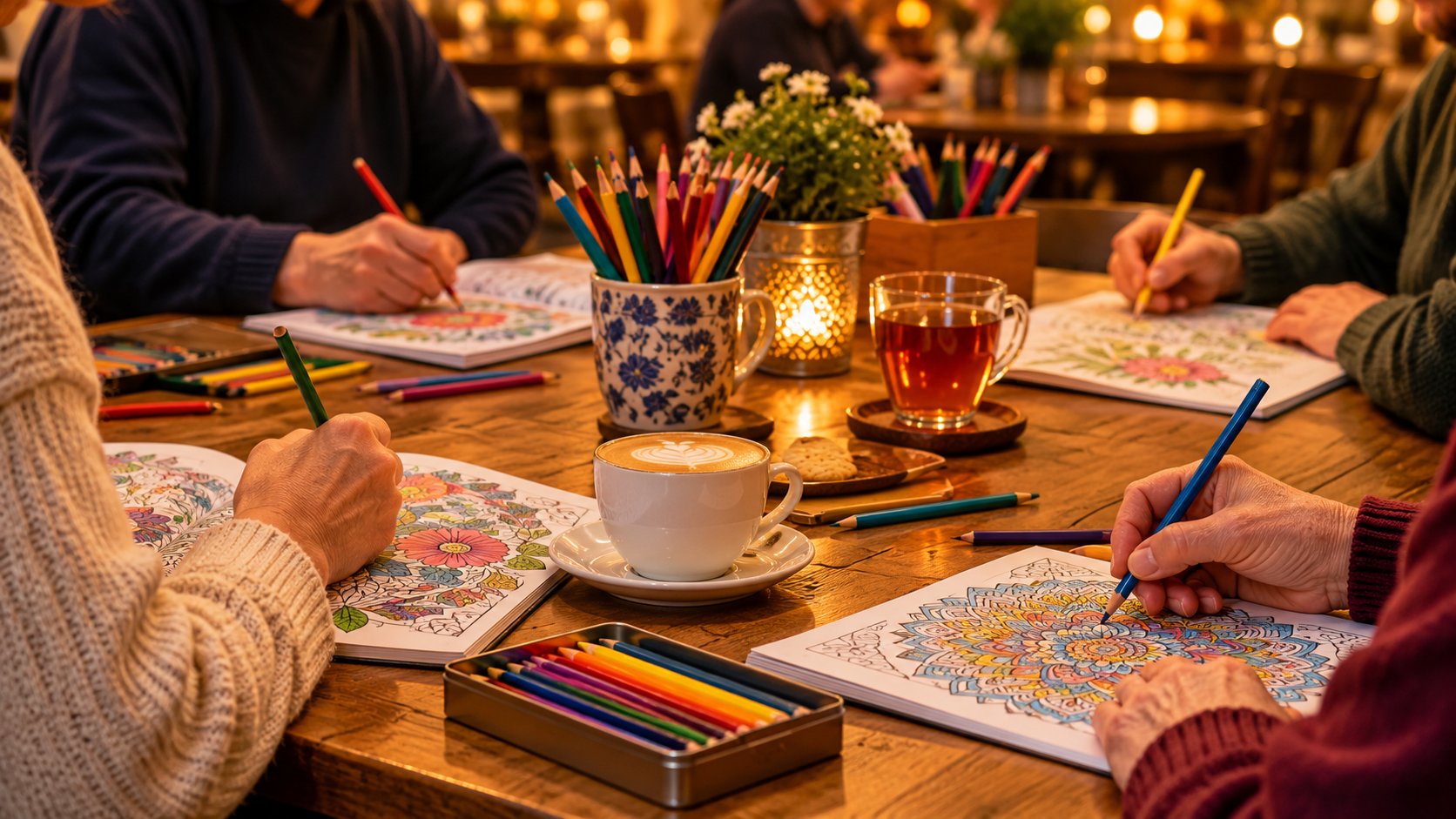
Coloring never died. It moved out of the living room.
Around 2015, adult coloring was everywhere — on bestseller lists, in newsagents, in airport shops. Then it faded from the headlines, and for years the common assumption was that the trend was a fad that had simply run its course.
What is happening now tells a different story. The hobby did not vanish; a piece of it changed shape. Adults are no longer only coloring alone at the kitchen table — they are meeting in pubs, libraries and community rooms to do it together. Small, local, often free club-style groups are popping up, and they are built around something the original boom never offered: other people.
This article looks at what is behind that shift — one documented case in detail, a second signal from the US, and the simple mechanics that make these groups work. (If you are here for the science of why coloring calms the mind, we cover that separately in why adult coloring is the best screen-free habit.)
First, the history: the 2015 boom and the quiet years
The modern adult coloring book genre is younger than most people think. The first commercially successful titles appeared in 2012 and 2013, but the breakout came in 2015: Johanna Basford’s Secret Garden and Enchanted Forest became Amazon’s top sellers, and by November of that year nine of the ten most wished-for items on Amazon.ca were adult coloring books. Crayola launched its own adult line the same month. By the end of 2016, publishers in the US were reporting that the craze had begun to cool.
That is the part most people remember. The part worth noticing is what came after: the books never left print, and the hobby kept a quiet, steady audience. More recently, “cozy coloring” has been circulating as a trend on TikTok — a lo-fi, comfort-first framing that speaks directly to people who want permission to do something undemanding with their hands.
So the stage for 2026 looks like this: a large pool of adults who already own coloring books or have tried the hobby, and a growing desire to spend time with other humans, offline. Coloring clubs are what happens when those two things meet.
Case study: “Outside the Lines” — a coloring club in a pub
The clearest documented example comes from Longbridge, in Birmingham, England. The local weekly paper, the Bromsgrove Standard, reported on 5 November 2026 the launch of a new group called Outside the Lines, founded by a Longbridge resident named Ben Cooper.
The details matter because they show the anatomy of this kind of group:
- It meets in a pub. Sessions run every Monday, 7–8pm, at The Cambridge (a Hungry Horse pub) in Longbridge town centre. No community centre booking, no formal venue — just the back of a pub on a slow Monday evening.
- It is free. All materials are provided at no charge, donated by members of the community who responded to the idea.
- It is drop-in. People can just turn up. No sign-up form, no course, no membership.
- There is no skill bar. Participants are encouraged to draw, colour and create whatever they wish. As Cooper told the paper: “Outside the Lines is a place where people can come and switch off for an hour. Whether you’ve had a busy day at work, you’ve got family pressures or you simply want some time for yourself, everyone is welcome.”
Cooper’s own path is telling. He has loved coloring since he was eight years old — as a child he drew scenes from favourite films and TV shows that did not have their own coloring books, “so I could create my own memories and be part of those moments.” He found the hobby supported his wellbeing as an adult, and the idea for an evening group came out of discussions at home: there was nothing like it in the local area.
The community’s response was immediate — supporters donated art and craft materials to get the project off the ground, and the group now runs as a simple weekly fixture: turn up, sit down, color, talk to whoever is next to you.
That last part is the real product. Not the coloring — the low-pressure company.
A second signal: San Antonio’s Coloring Club
One pub club could be a curiosity. But it is not the only example this autumn. In late October 2026, the San Antonio lifestyle outlet MySA ran a look inside a local Coloring Club — adults gathering in that Texas city for the same basic ritual, under the headline “‘I love the whimsy’”.
We could not verify the article’s internal details (the publisher blocks automated access), so we cite only what is certain: the club exists, an editorial team considered it worth profiling, and the framing was affectionate — the “whimsy” of adults coloring together. Two clubs, on two continents, profiled by local press within a two-week window in autumn 2026 does not prove a measured national trend. But it strongly suggests the same mechanism is surfacing independently in different places — which is exactly what a bottom-up revival looks like from the outside.
Why this format works: free, local, drop-in
Strip the two examples down and the same three design choices appear. They are worth understanding, whether you want to join a group or start one.
1. Free (or nearly free). Materials are donated or shared. This does two things: it removes the last excuse not to come, and it quietly signals that nobody is selling anything. A hobby group that costs nothing attracts people who are curious but not committed — which is most people.
2. Local and small. The Cambridge pub is a neighbourhood venue, not a national event. The group is reachable on foot or by a short bus ride. Small rooms create small talk; that is the point.
3. Drop-in, zero skill. There is no syllabus, no teacher, no judgment about staying inside the lines (despite the name, “Outside the Lines” is not a dare — it is permission). You can arrive tired, color badly for an hour, and go home. The bar for participation is roughly zero, and that is why it clears.
Notice what these groups are not: they are not craft workshops with fees and fixed schedules, and they are not meditation classes with an aura of self-improvement homework. They are closer to a book club with pencils — an excuse to gather, with a hands activity that fills silence comfortably. Coloring has one property that makes it uniquely suited to this: it occupies the hands and the eyes just enough that conversation feels optional, not obligatory. Nobody has to perform.
The background science, briefly
The calming effect of structured coloring has been studied directly: small experimental studies have found that coloring structured patterns reduces self-reported anxiety relative to free-form drawing — we summarized that research honestly, including its limits, in our mindfulness article. The headline is not “coloring is therapy”. It is that a structured, absorbing, screen-free task reliably lowers momentary stress for most people — and doing that alongside other people adds what solo coloring never had: a reason to leave the house.
There is also a quieter, cultural current worth naming. As AI-generated images flood every feed, purely analog hobbies have gained a certain pull — the satisfaction of making something physical, at human speed, with no model involved. We wrote about that pull in why hand-drawn wins in an AI-slop flood. A coloring club is the social version of that instinct.
How to find a coloring club near you
The groups are small and mostly below the radar of big event platforms, so try in this order:
- Your local library. Libraries were hosting adult coloring sessions as early as 2015 and many still run regular ones; check the events page or ask at the desk.
- Neighbourhood pubs and cafés. Search Facebook Events and Meetup for “colouring” or “coloring” plus your town. Smaller groups often live only there.
- Community boards. Noticeboards in cafés, health-food shops and community centres are where these groups advertise.
- Bookshops that stock adult coloring books. Staff usually know whether anything local exists — and some host sessions themselves.
No club nearby? Start one. It is easier than it looks.
Outside the Lines did not require funding, a venue contract or a business plan. Its start-up inventory was: one person who loved coloring, a pub with a quiet Monday, and a Facebook post. The materials came from the community after the idea was announced.
A minimal version you can copy:
- Pick a fixed, low-competition slot. Monday evening worked because nothing else happens then.
- Pick a venue that benefits from footfall (a pub or café) and ask for a corner table. The venue gains slow trade; you gain a room. Most will say yes.
- Bring the first set of materials yourself — a printable pack or one coloring book and a box of pencils covers the first several sessions. Let donations grow it.
- Announce it locally (community Facebook groups, the library’s board) and commit to running it for four weeks even if attendance is thin at first. Weekly fixtures compound; one-off events do not.
- Keep it skill-free and free of charge. The moment it becomes a class, it becomes homework — and homework is why people stop coming.
The bottom line
The story of the past decade is not “coloring boomed and then died”. It is that coloring first boomed as a purchase, then matured as a habit, and is now surfacing as a social habit — an hour a week at a pub table, with donated pencils and whoever turns up.
The evidence so far is a handful of well-documented local examples, not a national statistic — and that is exactly what a grassroots revival looks like in its first year: visible one pub at a time. If you already color alone, an hour with a group may add the part you did not know you were missing. If you have been meaning to try the hobby, a club removes every excuse at once: no materials to buy, no skill to have, no plan to make.
Just turn up. Outside the Lines runs every Monday, 7–8pm, at The Cambridge in Longbridge — and there is probably a table like it starting near you.
Sources: Bromsgrove Standard (5 November 2026), “New ‘Outside the Lines’ colouring group at Longbridge pub brings calm and creativity” by Tristan Harris (full text, quotes from founder Ben Cooper); MySA San Antonio (31 October 2026), “‘I love the whimsy’: A look inside San Antonio’s Coloring Club” (headline and date verified via Google News; internal details not verifiable due to publisher access restrictions); Wikipedia, “Adult coloring book” (historical timeline: 2012–13 first commercial successes, 2015 breakout via Basford titles on Amazon, Crayola’s November 2015 entry, US cooling by late 2016, “cozy coloring” TikTok trend 2025). Internal links: adult-coloring-mindfulness, ai-slop-flood-hand-drawn-wins.