← Back to Blog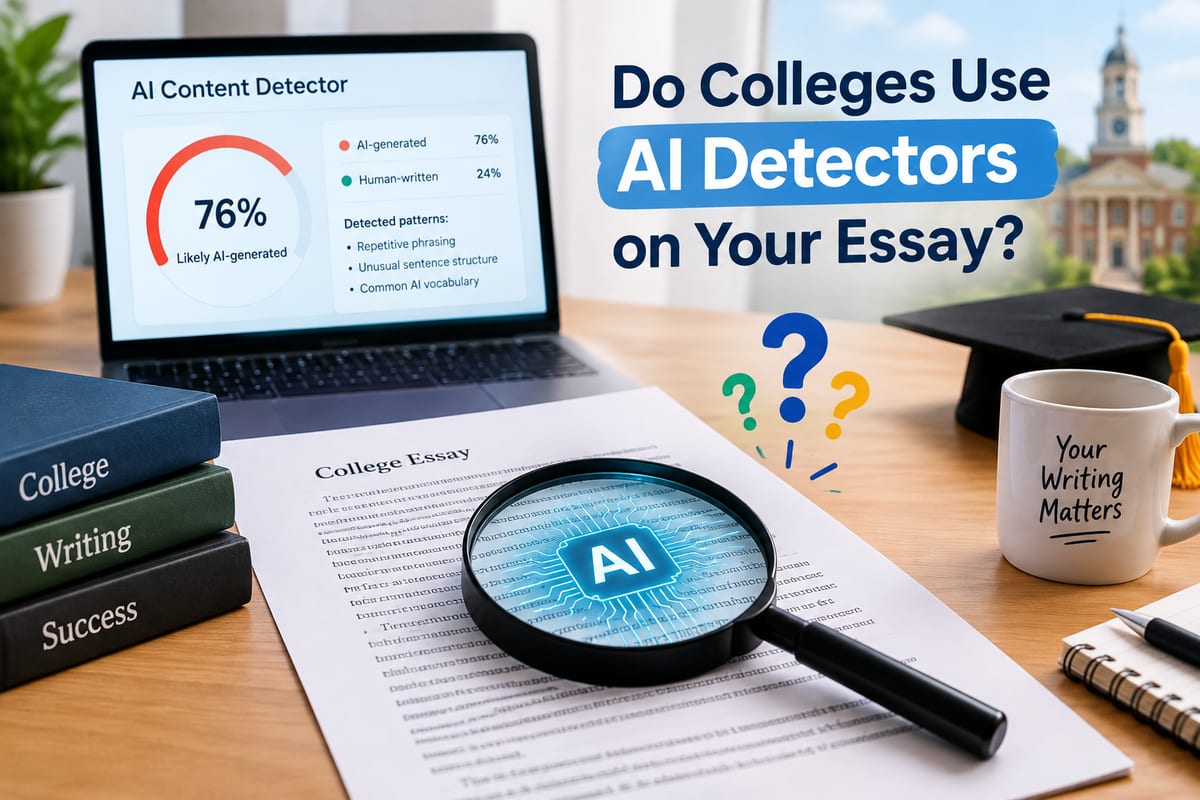
Do Colleges Use AI Detectors on Your Essay?
Every application season brings the same quiet panic: you used an AI tool to help polish a paragraph, and now you wonder whether a detector will flag the whole essay. Searches for this question spike every autumn for a reason. The answer is more nuanced than a simple yes or no, and it matters more than ever when deadlines are close.
What admissions offices actually say
- Most selective colleges have not announced routine AI-detection screening of application essays, and several have said publicly that they do not rely on a detector score to reject an applicant.
- What has changed is policy, not policing. Many schools now expect applicants to disclose when AI contributed to an essay, and some prohibit AI-generated text outright.
- Admissions readers are trained to judge voice, specificity, and consistency — the qualities an authentic essay shows and a generated one struggles to fake — rather than to trust a single tool’s verdict.
Why AI detectors are unreliable
- A detector produces a probability, not proof. It flags text it judges “too predictable,” which is exactly how careful, formal student writing often reads.
- They misfire most on non-native English speakers and on polished but genuinely human drafts, which is why universities and researchers have repeatedly warned against treating them as evidence.
- A false accusation is hard to appeal. A flagged essay can damage trust even when the student did nothing wrong.
What this means for your essay
- Write it yourself first. Detectors aside, an essay in your own voice is stronger and safer than a polished one you cannot explain.
- Use AI as an editor, not an author. Lean on it for brainstorming questions, tightening a sentence, or checking clarity — and keep the ideas, stories, and conclusions yours.
- Keep your drafts and notes. If anyone ever asks how the essay came together, your own process is the best evidence you have.
How to keep your writing clearly your own
- Read everything aloud. Spoken rhythm, specific details, and small human quirks are the hardest things to fabricate and the easiest to verify.
- Avoid generic openings and tidy template theses. Ground the essay in one concrete moment instead.
- Follow each school’s stated AI policy, and when in doubt, disclose.
The real risk is not a machine rejecting you. It is submitting writing that no longer sounds like you. Treat AI as a tool you direct, keep your own voice at the center, and the detector question stops being frightening.