ChatGPT Just Got a Storefront: What Business Hub and Wallet Mean for Small Online Sellers
One week, two announcements, one direction
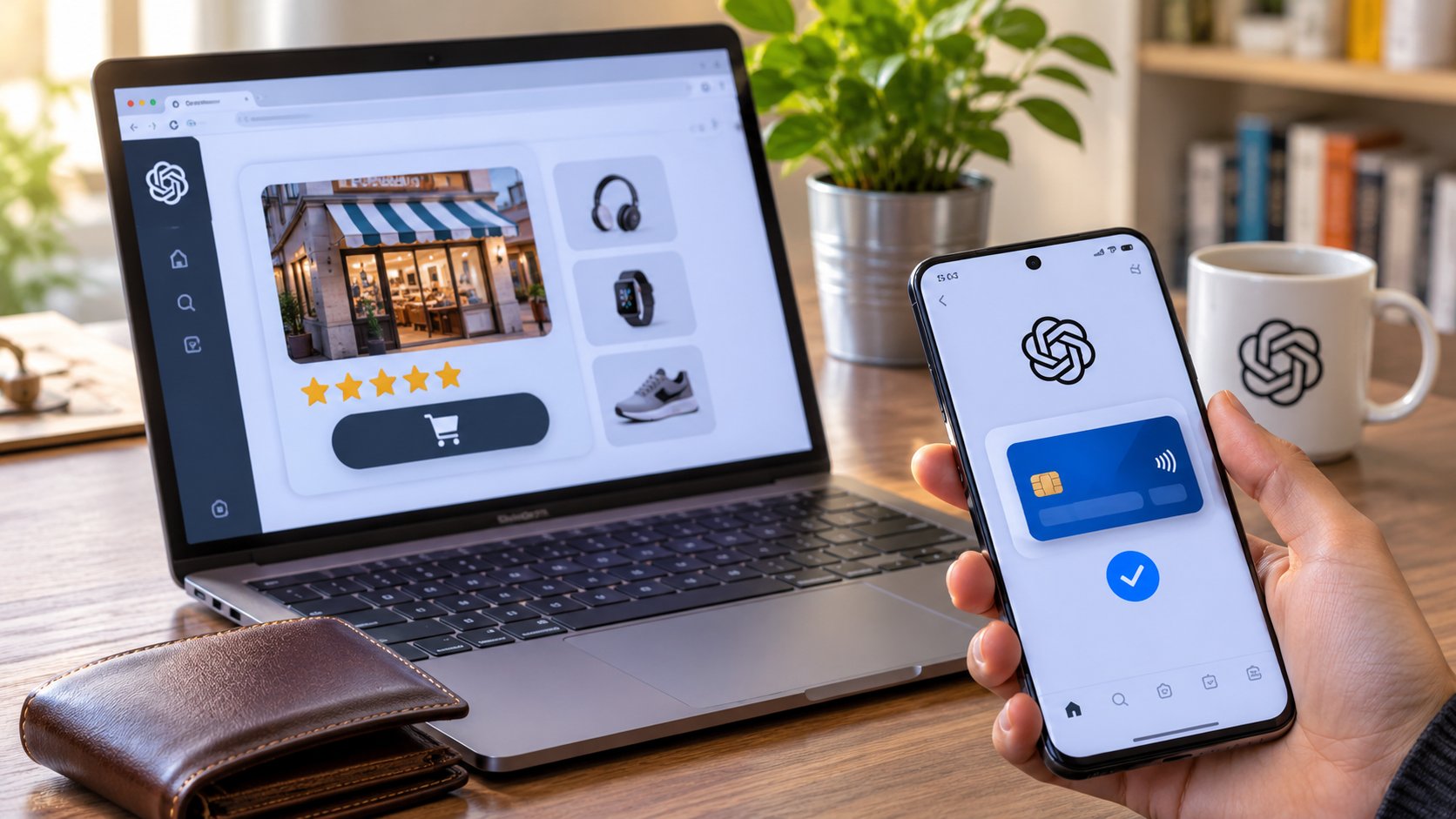
In the space of one week this November, OpenAI took two steps that together sketch out something bigger: ChatGPT is becoming a place where businesses are discovered — and where purchases can happen.
- Tuesday, November 10, 2026: the launch of Business Hub, where companies can create verified business profiles inside ChatGPT (currently in beta).
- Friday, November 13, 2026: the launch of ChatGPT Wallet, which lets OpenAI’s agents help users decide what to buy and then complete the purchase on their behalf.
Neither announcement alone changes your business this month. Together, they describe the direction the platform is heading: from a chat window that mentions products to an environment where products are presented, explained and bought. This article explains what each piece actually does, what is still missing, and — since we run a small digital shop ourselves — what a small online seller should realistically do now.
Part 1: Business Hub — your profile inside ChatGPT
The first piece is the quieter one, and for most small sellers it is the more immediately relevant.
According to TechCrunch’s report of the launch, Business Hub is a place where companies create business profiles — verified and updatable listings of what a company sells, in a format that closely resembles Google Business Profiles. Eligible companies can also launch a specialized business agent: a chat-facing assistant that answers ChatGPT users’ questions about that business and its products. And the hub provides limited insights — profile views, business mentions, website clicks — which will feel familiar to anyone who has used Google Analytics.
Two details are worth slowing down for.
Verification is a process. Profiles must pass a formal verification step before going live. OpenAI’s VP of Monetization, Benji Shomair, told journalists that there are “multiple verification methods that we use for different types of business in different markets” — without detailing them. In practice: expect to prove that the business is yours, and don’t be surprised if the process differs by country or business type.
It is in beta. Not every business can claim a profile today, and the feature set may change before general availability. The company itself framed the launch carefully: “Today’s announcement is an early step in bringing businesses more deeply into ChatGPT.”
The honest context is also important. This is not OpenAI’s first attempt at commerce. An earlier push — commission-based in-chat shopping with a checkout cart — was retired in March 2026 after failing to take off. Business Hub is the restart, with a different philosophy: instead of trying to make ChatGPT an Amazon-style store, OpenAI is making it a place where businesses present themselves and let users (and soon, agents) do the rest.
Part 2: ChatGPT Wallet — when agents can check out
The second announcement is louder, and its limits matter as much as its promise.
ChatGPT Wallet lets OpenAI’s agents — the company calls them “dots” — help a user decide what to buy and then complete the purchase. At launch, according to TechCrunch and the wire coverage that followed (CNBC, Reuters, Bloomberg, The Verge), the feature is limited to U.S. ChatGPT Pro subscribers, aged 18 and over, with a U.S.-issued Visa, Mastercard or American Express.
The design choices are sensible, and worth noting because they will shape what agentic shopping means for merchants:
- The user stays in control. Before checkout, the user reviews the items, the total, and the card being used. Approval happens with a biometric security check — Face ID or fingerprint — which also creates a record of the transaction.
- Card details never touch the agent or the merchant. The wallet charges the card through a payment token — a stand-in for the real card number.
- The merchant still gets what it needs. The agent passes on the shipping address and contact information automatically, and users keep their normal card rewards and dispute protections.
OpenAI says users will later be able to set spending limits and pre-approve purchase categories, so agents can operate more autonomously over time. And for merchants, the company published a Commerce Partner Playbook (developers.openai.com/commerce) — guidance for sites that want to support customers arriving via agents.
The honest caveats
Before treating this as a revolution, three realities:
First: agentic shopping volumes are still tiny. DoorDash reported only several hundred orders placed by AI agents; Uber said almost no one books rides through them. (For contrast, Meta’s Muse — a different kind of assistant — has passed 10 million users, with shopping among its top activities. The behavior exists; the plumbing is early.)
Second: not every merchant wants agents. Several major retailers actively block AI agents from their sites, and the largest to do so is Amazon, which steers users toward its own assistant instead. The checkout plumbing can be perfect and it still won’t matter if the storefront refuses the visitor.
Third: it is U.S.-only for now. Wallet’s launch cohort is American Pro subscribers. For sellers outside the U.S. (or selling to non-U.S. buyers), this is a signal to prepare, not a channel that is open yet.
What a small online seller should do now
We run this shop ourselves — a small digital catalog on Gumroad and Etsy — so this list is what we are actually doing, not theory:
1. Claim and verify your business profile when eligible. Business Hub profiles are free. A verified profile with accurate product information is the bare minimum for being present in ChatGPT’s answers. As availability expands beyond the beta cohort, this is a formality worth completing early — like claiming a Google Business Profile was a decade ago.
2. Make your product pages agent-readable. An agent can only recommend what it can parse: clear product titles, structured descriptions, visible prices, working links, public pages without paywalls or aggressive bot-blocking. If your site blocks crawlers, fix that before anything else — it also blocks the agents.
3. Keep your buy links alive. Agentic checkout will not replace your own checkout for a long time. Every link that works today still matters; every broken one is a lost customer, human or agent.
4. Watch the Commerce Partner Playbook. OpenAI’s merchant guidance (developers.openai.com/commerce) is the best public signal of what “agent-friendly” will mean technically. Bookmark it; check it occasionally; implement when it becomes concrete.
5. Don’t reorganize your business around it. The earlier ChatGPT shopping attempt was retired within months. Budget attention accordingly: prepare the basics, measure what happens, and keep building what you own — your catalog, your email list, your audience. We wrote before about why AI spending grows while its earnings contribution lags; the same discipline applies to your own adoption of new AI channels.
The bottom line
In one week, OpenAI built the storefront layer of ChatGPT: profiles for businesses to present themselves, and a wallet for agents to pay with. The launch is small, beta, and mostly American — but the direction is unmistakable, and unlike the first attempt, this time the pieces are being assembled with merchant verification and payment infrastructure from the start.
For small sellers, the move is not to chase every announcement. It is to do the five boring things above — claim the profile, keep pages readable, keep links working, watch the playbook, and stay focused on what you own. The agents are coming to your store either way; the only question is whether they find a clean, readable shop when they arrive.
Sources: TechCrunch, “OpenAI rolls out new business profiles, making ChatGPT just a little bit more like Google” (November 10, 2026, Lucas Ropek — full text, OpenAI statements and Benji Shomair quote); TechCrunch, “ChatGPT’s new Wallet lets AI agents shop and check out for you” (November 13, 2026, Sarah Perez — full text); corroborating coverage: CNBC, Reuters, Bloomberg, The Verge (November 13, 2026 — headlines); context: TechCrunch (March 24, 2026) on the retirement of OpenAI’s earlier in-chat checkout. Internal links: enterprise-ai-spending-stall-ramp-index, making-yourself-obsolete-with-ai.